Harvard Crimson Articles on Edward C. Banfield Online

Source: TheCrimson.com

Happily, the Harvard Crimson makes many of its articles about Banfield available online. You can see them at: http://www.thecrimson.com/search/?cx=013815813102981840311%3Aaw6l9tjs1a0&cof=FORID%3A10&ie=UTF-8&q=%22edward+c.+banfield%22&sa=

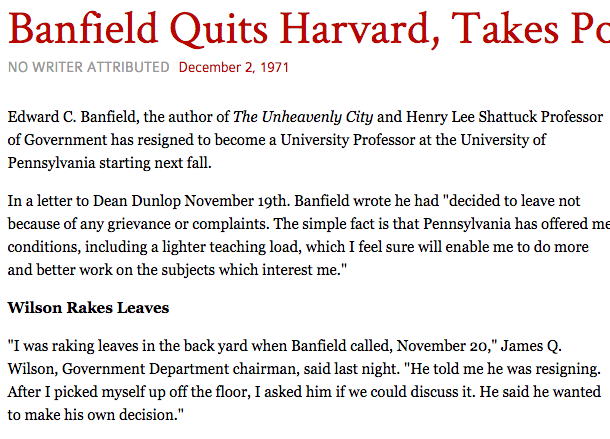
This one from December 2, 1971, regarding Banfield’s few-year departure from Harvard, features a leaf-raking James Q. Wilson, who was a student and dear friend of Ed’s. Read it at http://www.thecrimson.com/article/1971/12/2/banfield-quits-harvard-takes-position-at/

Patricia McLaughlin, “Is the Author of ‘The Unheavenly City’ Really Diabolical?” Pennsylvania Gazette, November 1973

Edward C. Banfield went from the University of Chicago to Harvard, and then was lured to the University of Pennsylvania for a short time. Thomas E. Lanctot, a former Banfield student there, graciously provided a paper photocopy of this article. (Presently, the Pennsylvania Gazette’s online archive does not go back to 1973.)

At UPenn, Banfield was harassed by Bonnie Blustein, who trashed him in the school newspaper as a neo-Nazi. She and others also  disrupted his lectures.

This article provides some biographical material on Banfield and includes a photograph of him in Rittenhouse Square. It also pokes some fun at the often ludicrous criticisms of Banfield’s The Unheavenly City (Boston: Little, Brown, 1970). You can read this article in its entirety above. The scroll bar on the right-side of the frame allows you to move through the pages. Click the Scribd button on the frame around it to view a larger copy in a new window.

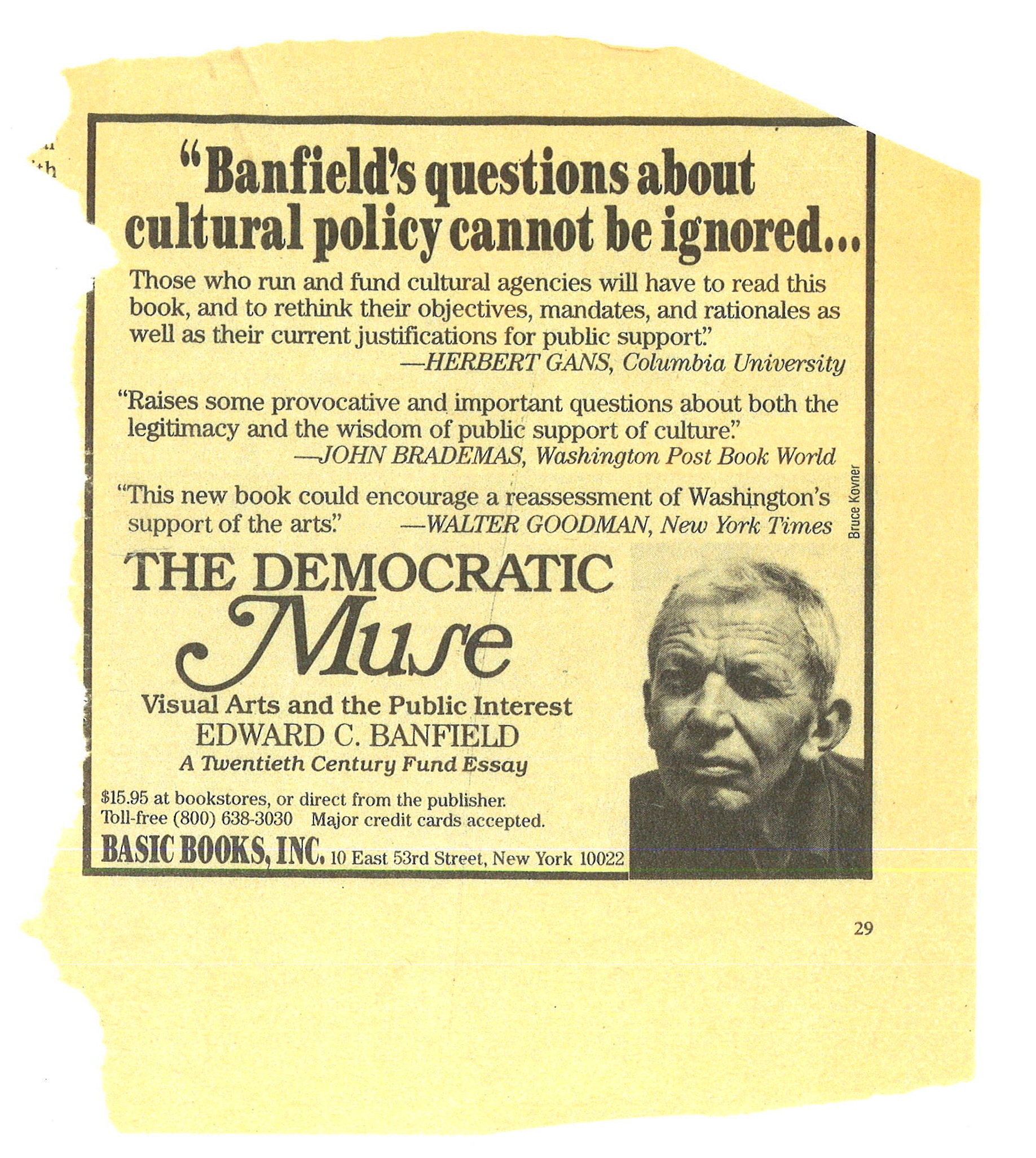
Advertisement for Edward C. Banfield’s Democratic Muse

Democratic Muse Advertisement Cropped
Source: Basic Books

The Democratic Muse (New York: Century Fund) annoyed many cultural elites when it was published in 1984. Even the late Hilton Kramer, who usually is considered a conservative, was outraged. The Democratic Muse is Banfield’s most Socratic book—it unleashed reason upon federal arts policies.

Banfield examined the various arguments for government funding for arts and found them nonsensical and contradictory. So, for example, if looking at great painting is good for the public, then would it not make sense to cease funding museums (which few Americans can access), sell off the masterpieces, and use the proceeds to send high quality copies of paintings to public schools nationwide?  Ultimately, Banfield exposed much of arts policy as subsidies for the upper class in major metropolitan areas.

Above is a print advertisement that Banfield sent to one of his former University of Pennsylvania students, Thomas Lanctot, who provided a copy of it to this website. Clicking on the image above will expand it to full size. On the right, one sees the photographer was Bruce Kovner. This is amusing, as Kovner was a Banfield student at Harvard, and Kovner went on to start Caxton Associates and become a billionaire. (Kovner, it should be added, remained a dear friend of Ed and Laura Banfield to the end.)

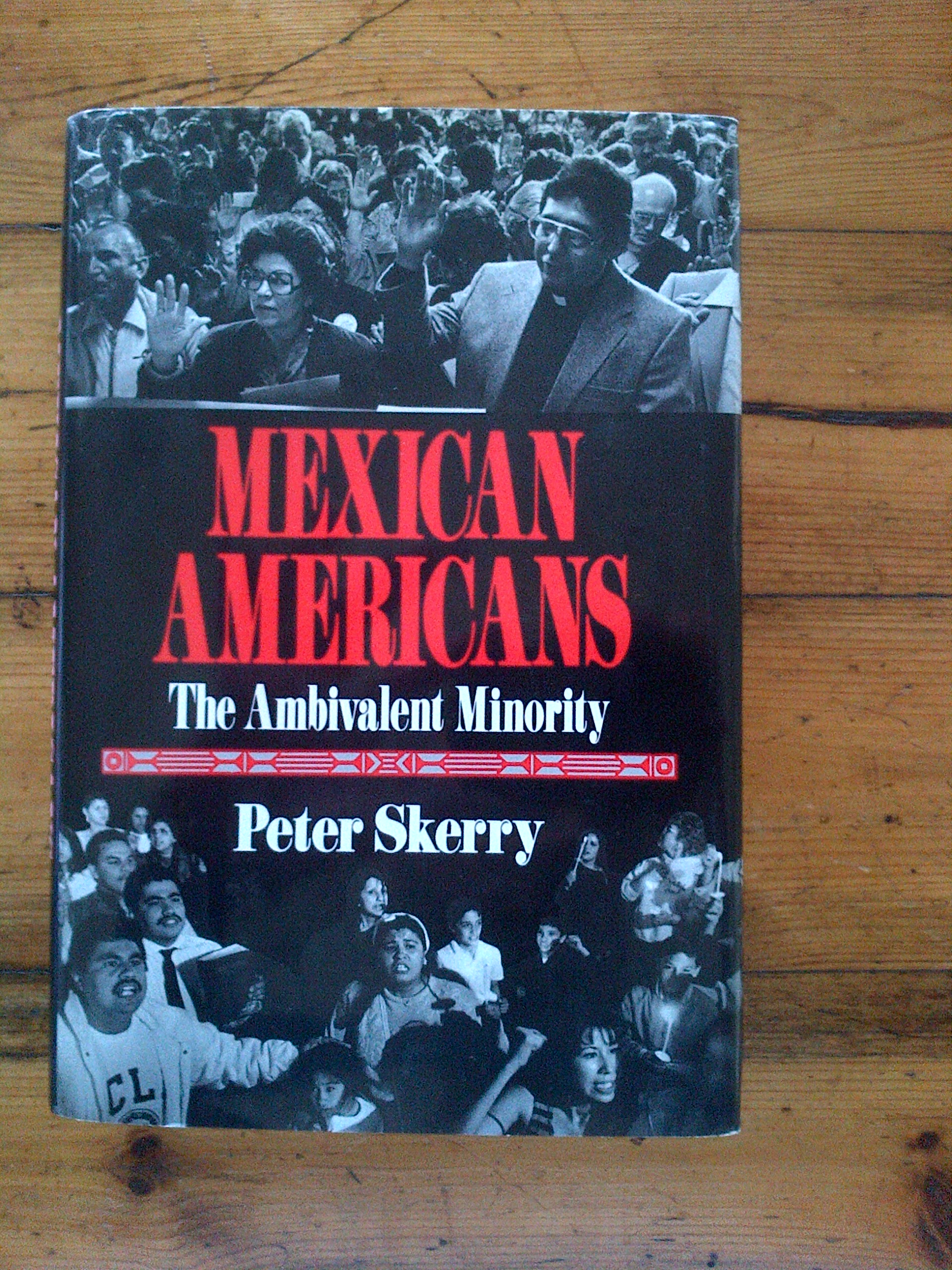
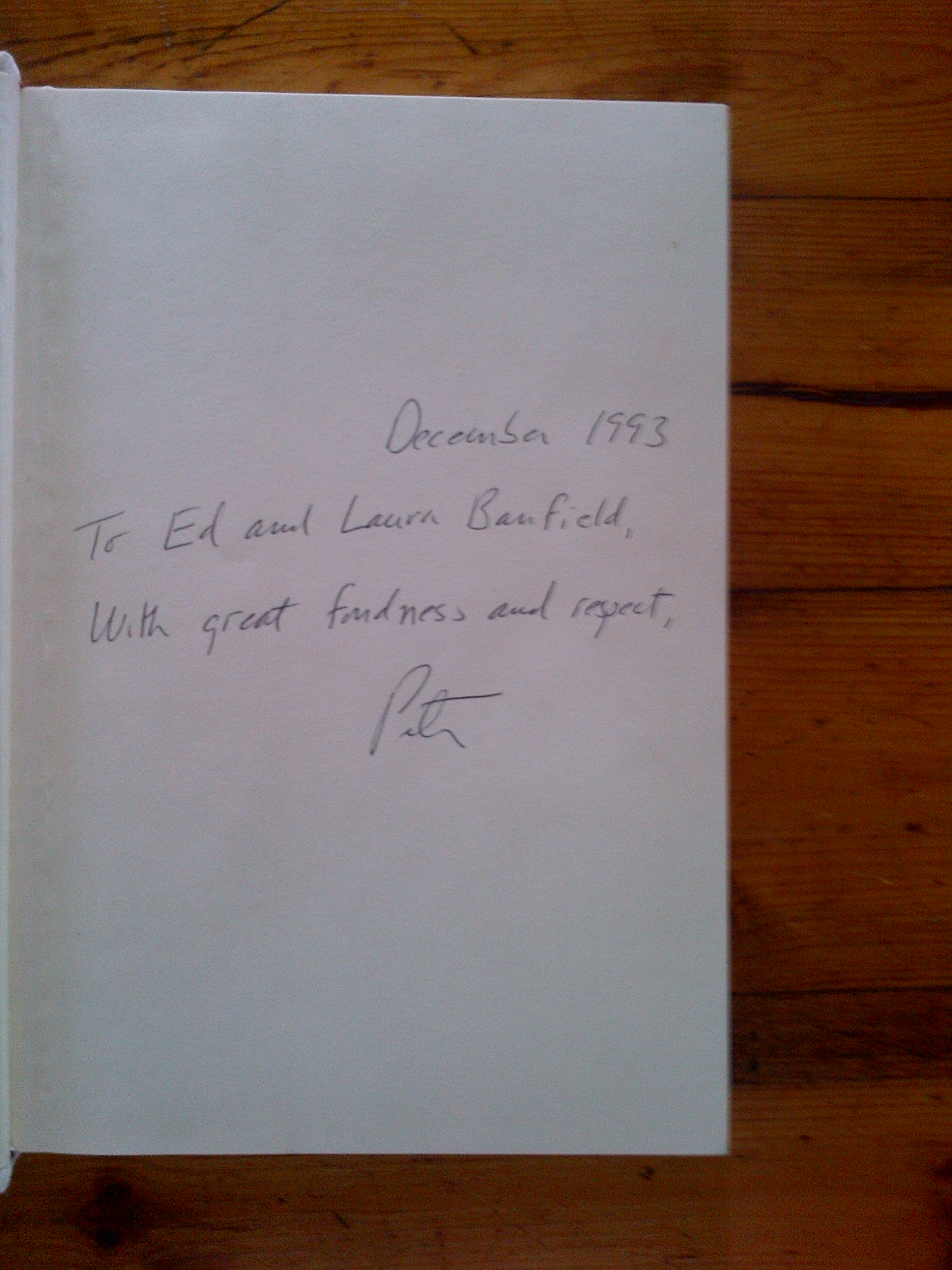
Peter Skerry Book Inscribed to Edward C. Banfield

Peter Skerry is a professor of political science at Boston College. His Mexican Americans: The Ambivalent Minority (Harvard University Press, 1993) won the 1993 Los Angeles Times Book Prize.

Skerry earned his Ph.D, in government from Harvard. He was as student of Banfield’s, and  James Q. Wilson, a Banfield student, co-author, and friend, was one of Skerry’s dissertation advisers.

Two photographs of a copy of a Skerry-inscribed copy of Mexican Americans are below. The inscription reads, “December 1993 To Ed and Laura Banfield, with great fondness and respect, Peter.”

Source: Kevin R. Kosar

Source: Kevin R. Kosar

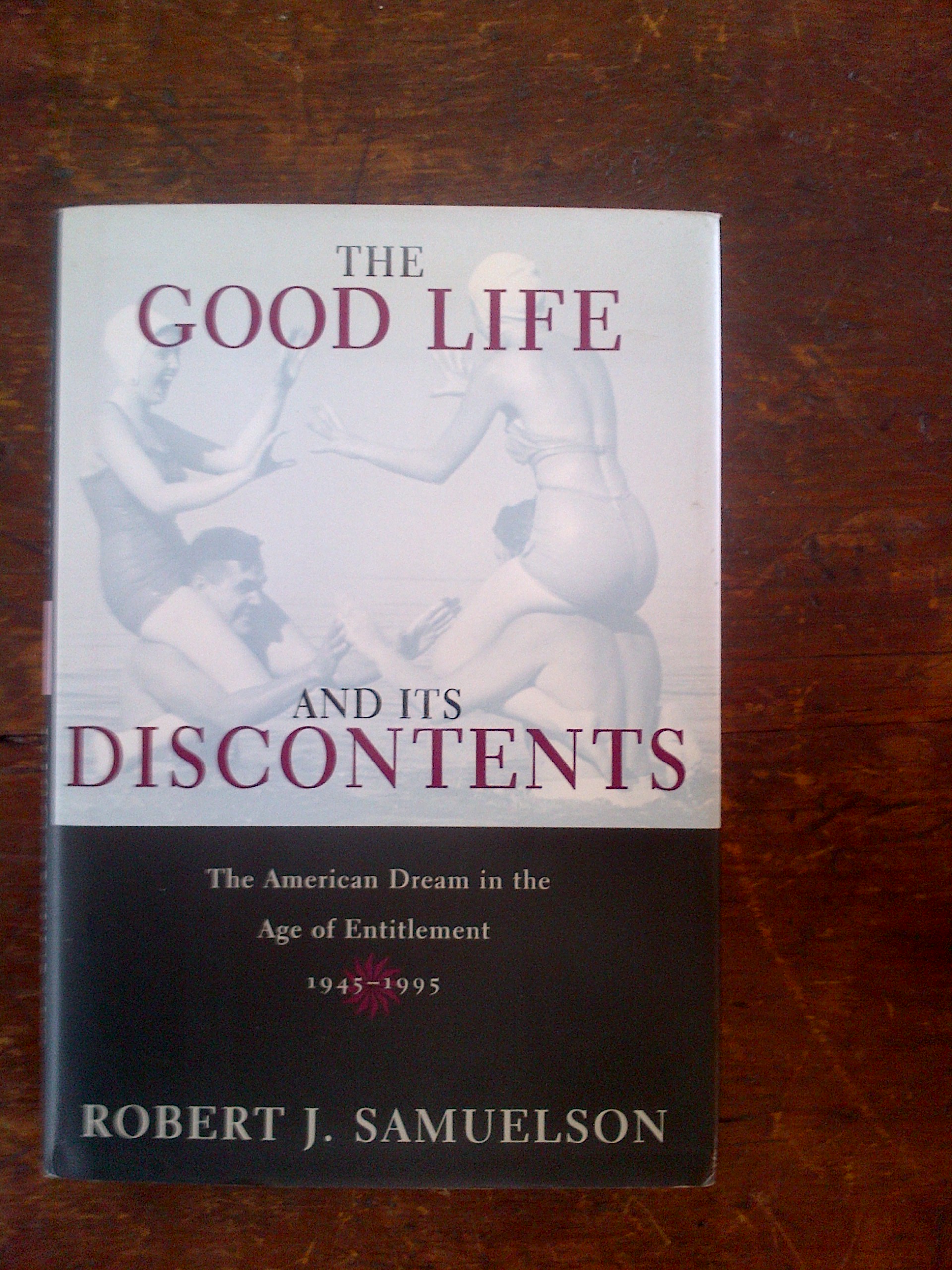
Robert J. Samuelson Book Inscribed to Edward C. Banfield

Robert J. Samuelson, the provocative columnist for the Washington Post, was a student of Banfield.  He wrote a touching tribute to Banfield upon his death: “The Gift of a Great Teacher,” Washington Post, October 14, 1999.

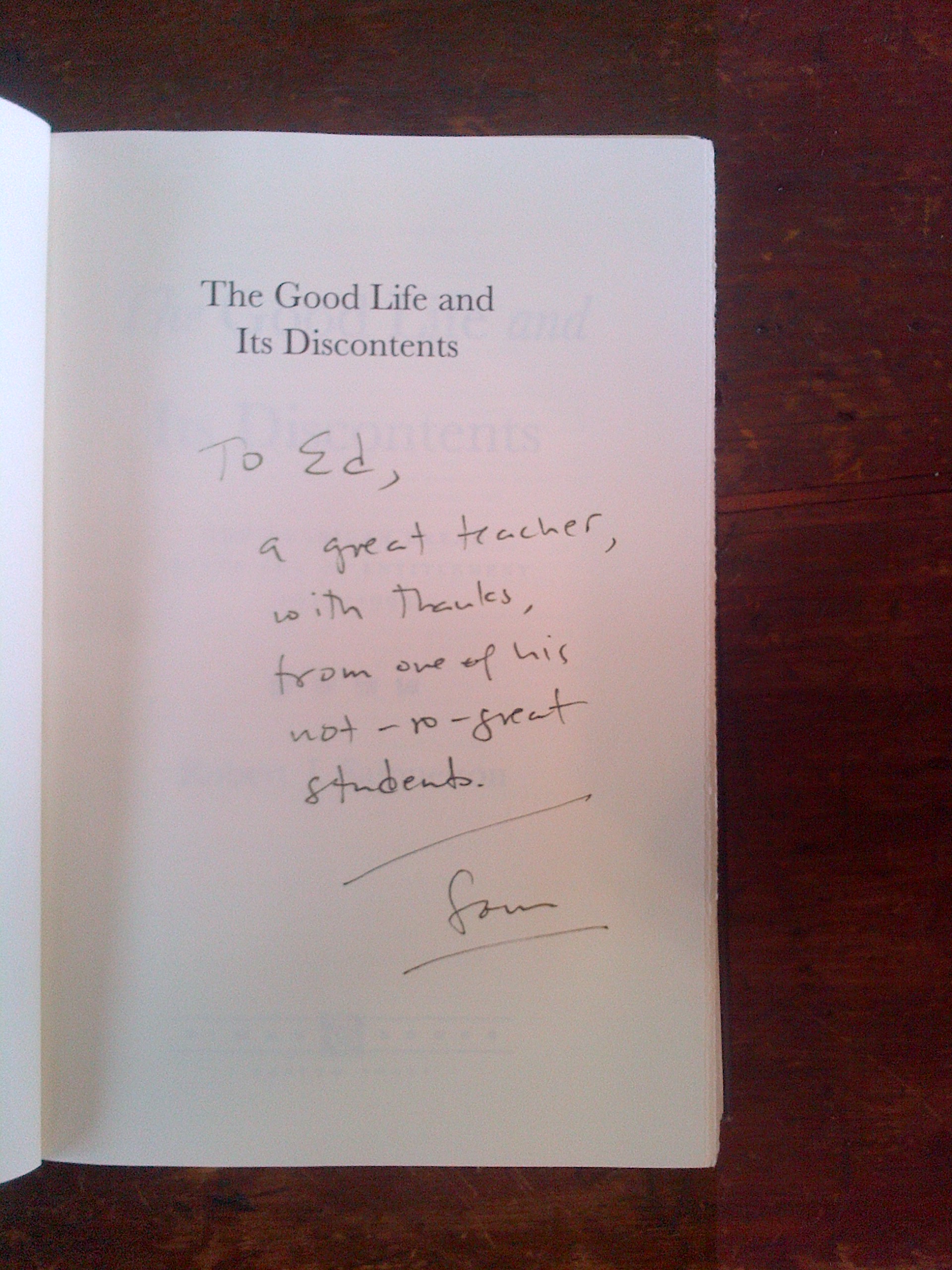
Below are shots of a copy of Samuelson’s impishly titled The Good Life and Its Discontents: The American Dream in the Age of Entitlement, 1945-1995 (Times Books, 1997) that he gave to Banfield. The inscription reads, “To Ed, a great teacher, with thanks, from one of his not-so-great students.  Sam”

Source: Kevin R. Kosar

Source: Kevin R. Kosar

What Did Edward C. Banfield Read?

The answer is, “Just about everything.”

Banfield himself wrote broadly, his books and articles covering topics such as agricultural policy, the U.S. Constitution, foreign aid policy, poverty, urban governance… Banfield even penned a few short didactic, short stories.  It is not for nothing that the late James Q. Wilson referred to his former teacher as “the man who knew too much.”

Ed and his wife Laura were bibliophiles—one cannot even venture to guess at how many books they acquired. Their collections held titles on nearly every topic matter: gardening (including mushroom identification), astronomy, history, philosophy, technology, fiction current and century or more old, and, not surprisingly, the classics (e.g., Plutarch). Below are two photographs of a tiny slice of Ed’s politics and history collection.

The Washington Post Mentions Amoral Familism

A little over a year ago, the Economist magazine invoked”amoral familism” in the course of explaining the flight of competent, educated Italians from their homeland. These young people, the magazine suggested, were frustrated by the “system of raccomandazioni, or connections (often through families), that rules the [Italian] labour market.” This system is the outgrowth of “amoral familism,” a term Banfield coined in The Moral Basis of a Backward Society to refer to the “the inability [of a community] to act together for their common good or, indeed, for any end transcending the immediate, material interest of the nuclear family.”

In the July 1, 2012 Washington Post newspaper, Steve Pearsltein cites amoral familism in explaining Italy’s productivity crisis:

More than in any other of the advanced economies, business in Italy remains family businesses, from the smallest farms and trattoria to some of the largest supermarket chains, industrial groups and fashion houses. Starting companies comes naturally — Italy remains one of the most entrepreneurial countries in the world. But relatively few grow to be very large, and even those that do tend to remain private, relying on family members to fill all key positions and on retained earnings for capital, supplemented by loans from friendly local bankers. Closely related to the distaste for meritocracy and the obsession with family is the weak sense of a civic culture or virtue in Italy….The all-too-common Italian attitude is that while taking responsibility for family is fundamental, beyond that, “What can you do?” This concept of the “amoral family,” first articulated by American political scientist Edward Banfield, may not be surprising for a country that, for 1,500 years after the fall of the Roman empire, was constantly being taken over by one foreign power or feudal state after another. It was perhaps only natural that Italians are inclined to view government as hostile, taxes more like tribute and the court system more an instrument of social control than a source of justice. The problem, however, is that if people don’t expect each other to be fair and honest, if they don’t trust the government or can’t rely on the courts, if they don’t see that their willingness to wait their turn or throw out their trash will be reciprocated by others — then it’s hard to create an economic environment where highly competitive businesses can grow and prosper….(read more)

Banfield’s Moral Basis of a Backward Society was published in 1958; that it still is being cited is indicative of its high quality, and its intuitive appeal as an explanatory hypothesis.

Mention: The Economist Mentions The Moral Basis of a Backward Society

The June 9, 2011 copy of The Economist carries a piece mentioning Banfield’s Moral Basis of a Backward Society, his seminal analysis of a small town in Italy.

Faced with having to wait until they are the age of their grandparents to become senior, many of Italy’s best and brightest leave. Universities in America and Britain are full of Italian academics too ambitious to sit around for decades to get tenure in Italy. International bureaucracies such as the World Bank, IMF and OECD are replete with Italians wielding PhDs. Brussels is another escape hatch: Italy is a great provider of dedicated Eurocrats. Perhaps the single most damning indicator of Italy’s current economic health is that it is the only net exporter of graduates among rich European countries, something more commonly associated with developing countries than with developed ones…Many of Italy’s graduates leave to escape the system of raccomandazioni, or connections (often through families), that rules the labour market. Examples of such practices can be found in every country, but Italy is different for two reasons: raccomandazioni are ubiquitous and rarely questioned. It might be tempting to ascribe this preference for connections over qualifications to what Edward Banfield, an American sociologist, called “amoral familism”. In a book on poverty in southern Italy, “The Moral Basis of a Backward Society”, published in 1958 but still controversial today, Banfield argued that Italian family bonds are so tight that they prevent people from coming together to create outcomes that benefit a larger number. The thesis was intended as an analysis of a single village but has often been read as a condemnation of an entire nation. (Read more.)

More than 60 years after publication, the idea of amoral familism remains in intellectual currency. That is a rare thing in the social sciences.

Article: Edward Banfield on the Promise of Politics and the Limits of Federalism

Kimberly Hendrickson wrote this article for a special issue of Publius devoted to Conservative views on federalism.

Those with subscriptions to Publius and those at libraries that subscribe to JSTOR and Oxford journals can view it by clicking here.

Full citation: Kimberly Hendrickson, “Edward Banfield On the Promise of Politics and the Limits of Federalism,” Publius, vol. 34, issue 4, Fall 2004, pp. 139-152.

Archives with Materials on On Edward C. Banfield

Edward C. Banfield Collection, City Planning and Landscape Architecture Collection, University of Illinois, Champagne-Urbana. Repository of Edward C. Banfield, ed., Reports on American Cities, (Center for Urban Studies at MIT and Harvard: 1960-1963).

[Additional information to come.]